
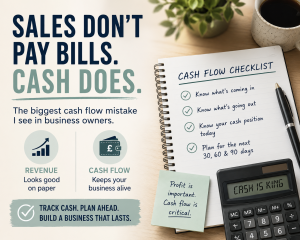
The Biggest Cash Flow Mistake I See in Small Businesses


Most business owners track sales.

Very few track cash.

And that simple mistake is often the difference between a business that thrives and a business that constantly feels under pressure.

I regularly speak to business owners who proudly tell me they’ve had a record sales month. Their turnover is growing, enquiries are increasing, and business appears to be moving in the right direction.

Yet when we look beneath the surface, they are struggling to pay suppliers, delaying their own wages, relying on overdrafts, or worrying about how they’ll cover next month’s expenses.

Why?

  • Because sales and cash flow are not the same thing.
  • Revenue Looks Good on Paper. Cash Pays the Bills.
  • Revenue tells you how much you’ve sold.
  • Cash flow tells you how much money is actually available to run your business.

You can invoice £20,000 this month, but if your customers take 60 days to pay, that money isn’t helping you today. Meanwhile, your rent, software subscriptions, payroll, taxes, utilities, insurance and supplier invoices still need paying.

This is why businesses can be profitable and still run out of cash. In fact, poor cash flow management is one of the most common reasons businesses fail, even when demand for their products or services is strong.

The Dangerous Myth of “We’re Busy, So We Must Be Fine”

Many business owners assume that being busy means being successful.
It doesn’t. I’ve seen businesses generating six-figure revenues that were constantly stressed because:

• Invoices were paid late
• No one was chasing outstanding debts
• Payment terms weren’t enforced
• Costs had quietly increased
• There was no visibility of future cash requirements

The result?
A constant cycle of firefighting. Instead of making strategic decisions, they spend their time worrying about what needs paying next.

The Four Numbers Every Business Owner Should Know

You don’t need complicated spreadsheets or a finance degree but you do need visibility. At a minimum, every business owner should know:
1. What Is Owed To You
How much money is currently outstanding?
Which invoices are overdue?
Who owes you the most?
If you don’t know this number, you’re flying blind.

2. What Is Due To Go Out
What payments are leaving your account this week, this month, and next month?
Many cash flow problems aren’t caused by lack of sales. They’re caused by lack of planning.

3. Your Current Cash Position
How much cash is actually available today?
Not projected.
Not expected.
Not promised.
Actual cash in the bank.

4. Your Future Cash Position
What does the next 30, 60 and 90 days look like?
Businesses that grow sustainably plan ahead.
Businesses that struggle often only react when problems appear.

Profit Doesn’t Equal Cash

This is one of the biggest misconceptions in business.

You can be profitable on paper but still have no cash.

A simple example:

You invoice £15,000.
Your accountant records £15,000 revenue. Your profit and loss account looks healthy. But if only £3,000 has actually been paid, you still have a cash flow problem.

The profit exists on paper.
The pressure exists in reality.


Small Changes Create Big Improvements


The good news is that cash flow problems are often easier to fix than people think.
Some simple improvements include:

  • Tighten Payment Terms – make sure clients understand when payment is due and what happens if it isn’t received.
  • Invoice Promptly – the sooner invoices are issued, the sooner payment can begin.
  • Chase Early – many businesses wait too long before following up.

A polite reminder before an invoice becomes overdue can dramatically improve payment times.

Forecast Weekly

A simple cash flow forecast can highlight problems weeks or months before they become critical.
Review Expenses Regularly
Subscriptions, software, memberships and services can quietly drain cash if they’re not reviewed regularly.

Cash Flow Gives You Options
Strong cash flow doesn’t just help you survive it gives you options.

You can:
• Invest in marketing
• Hire support
• Purchase equipment
• Expand your services
• Take opportunities when they arise

Without cash, even great opportunities can become impossible to pursue.

Final Thoughts

Most business owners focus on sales because sales feel exciting.

Cash flow feels less glamorous however cash flow is what keeps the lights on.
It’s what pays your team. It’s what allows you to grow with confidence.
Revenue is important. Profit matters. But cash flow is the number that determines whether your business can breathe.

The businesses that succeed long-term aren’t always the ones generating the highest sales. They’re the ones that understand where their cash is, where it’s going, and what needs to happen next. Sales look good on paper, cash keeps businesses alive.

Need help getting a clearer picture of your cash flow?

Comment CASH or get in touch via https://thegrowthcoachuk.com to request my simple Cash Flow Tracker and start taking control of your numbers today.


Know Your Why – 5 reasons it’s important in your business


As entrepreneurs, we all have our own personal reasons for going down the route of self-employment and every one of us has a valid reason whether this is for a better work-life balance, more family time, an increase in income or some reason only known to you. These reasons are important and often along the way we forget why we chose this route. Here are five reasons why knowing your “why” is crucial in your business:


  1. Focus on Goals: Your “why” serves as the driving force behind your business goals. When you have a clear understanding of why you’re in business, whether it’s for financial freedom, making a positive impact, or pursuing a personal passion, you can align your goals with this purpose. This alignment helps you stay focused and committed, even when faced with challenges or setbacks.


  1. Clarity in Decision-Making: Knowing your “why” provides clarity in decision-making. When you understand the deeper purpose behind your actions, it becomes easier to make strategic choices that are in line with your goals and values. This clarity helps you prioritize tasks, allocate resources effectively, and make decisions that contribute to your long-term success.


  1. Passion and Motivation: Your “why” ignites your passion for your business. When you’re passionate about what you do, it becomes easier to inspire yourself and others. Passion is a powerful motivator that can drive you to overcome obstacles, work tirelessly, and continuously seek ways to improve and innovate.


  1. Resilience: Business inevitably comes with its share of challenges and setbacks. Knowing your “why” acts as a source of resilience. When you’re deeply connected to your purpose, you’re more likely to persevere through tough times and bounce back from failures. It gives you the strength to keep going, adapt to change, and learn from your experiences.


  1. Integrity: Your “why” helps you maintain integrity in your business. When your actions align with your values and purpose, you build trust with your customers, employees, and stakeholders. Integrity is essential for long-term success and a positive reputation in the business world.


Understanding your “why” requires introspection and self-awareness. It’s about uncovering your true motivations and values, which may evolve over time. Your “why” can also serve as a powerful tool for communication and marketing, as it allows you to connect with your audience on a deeper level by sharing the authentic story behind your business.


Ultimately, knowing your “why” not only guides your business decisions but also enriches your entrepreneurial journey by giving it meaning and purpose. It’s a driving force that keeps you inspired, resilient, and committed to your business goals.


What is your why?

7 Steps to Starting up

Where do you start when you are looking to go self-employed?

I run workshops for those who are looking to start a business and recently I have been approached by several people regarding the steps to starting up so here they are! The below are the pre trading steps, the ones you need to get right BEFORE you can sell your goods or services

I started my company with £20, that was the total amount I had free to invest in my business idea. Looking back it was pure madness but I did it!

Below are the basics of what you need to do as the bare minimum when thinking of starting up:

  1. Identify WHAT you want to do, do you want to convert a hobby to a business? Do you have experience in the industry you want to set up in?
  2. Write a business plan detailing the service you want to provide. The business plan needs to have all of the necessary elements to enable others who read it to know EXACTLY what you do. There is a fine line between telling them what you do and giving them enough information to do it themselves however I’m a firm believer that there is something unique in every one of us that makes our business unique. I could try to replicate what you do but I wouldn’t succeed as I haven’t the same driving factor you have.
  3. Complete a personal survival budget spreadsheet so that you know exactly how much you need to survive per month for you and your family. The family expenses need to be covered before anything else.
  4. Complete a cash flow and sales forecast- you will need to have some idea on your pricing structure in order to complete this. You will need this though to enable you to see how much you could earn and how much you will need to continue to trade.
  5. Identify your start up costs, this will enable you to see if ‘realistically’ you can afford to start your company. Don’t go for the ‘flashy’ options. You can build your business on a budget, I did! You need functional rather than flashy at this stage. Don’t sign up to expert advice if it’s not free at this stage, if you don’t know what you are offering you cannot expect experts to know. No one knows your business the way you do. Include materials essential to your starting up however leave the ‘nice to haves’ until you have money
  6. If you need finance identify where you can obtain this from. If you are interested in a start up loan you will need the above documentation in order for them to know how much you want to borrow. If you already have funds that you can use be careful not to use them all at once. Stick to buying the basics until you are sure that you definitely want to start the business
  7. Talk to people about what you are doing, speak to friends and family and ask them to be honest with you. They will often give you the reality check. Take their feedback on board.

Without knowing these there is no point in starting up.

Are there any tips that you could offer those who are looking to start up in business?

Financial Habits to Improve Efficiency for Business Growth


There are many challenges facing companies today, of these the following are perceived to be the biggest:

  • Marketing – the cost of your marketing seems like a good investment however have you ensured that you and your marketing specialist are on the same page? Have you been clear about your objectives? Have you ensured that your marketer knows what you are looking to achieve?
  • Growing Sales – sales are needed for growth however if your cash flow is reduced through late payments you’ll have less working capital to utilise on further sale and marketing costs
  • Controlling Costs – finding the best possible value for money with supplies and goods as well as ensuring prompt payment
  • Managing Cash Flow– if you prefer not to call for payment, consider outsourcing if necessary, asking for payment should not jeopardise your relationship with your customer, if anything it should strengthen the relationship as they will realise you intend to make your business a success.
  • Maintaining Margins – the cost of credit should be built into the quote whilst remaining competitive, this goes back to finding the best possible value for money with suppliers and goods as well as ensuring prompt payment
  • Granting Credit– the credit account- when to offer credit to customers. Although a credit account is important it’s even more important to monitor your exposure
  • Getting Paid– probably the most important. If you ask for your payment others will take you seriously, you don’t need to ask for the payment when you call, ask them if they were happy with the service, tell them it’s a customer service call to check on the service you’ve provided. Ask them if they have received the invoice, is it in the correct format?

In this current climate it is essential to minimise the risks and maximise the cash flow to ensure business survival and growth. This will aid financial efficiency.

By breaking down these challenges it is easier to identify the specifics within the areas that need addressing. To grow sales the business needs cash, to bring cash into the business costs need to be managed and debts from previous sales need to be collected

The startling reality is that for every £1 granted on credit up to £5 is ‘lost’ until payment is received- this figure includes the raw materials purchased, rent & wages….