
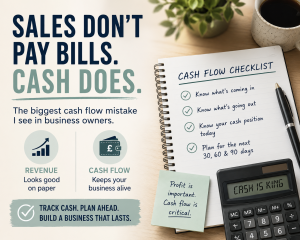
Most business owners track sales.
Very few track cash.
And that simple mistake is often the difference between a business that thrives and a business that constantly feels under pressure.
I regularly speak to business owners who proudly tell me they’ve had a record sales month. Their turnover is growing, enquiries are increasing, and business appears to be moving in the right direction.
Yet when we look beneath the surface, they are struggling to pay suppliers, delaying their own wages, relying on overdrafts, or worrying about how they’ll cover next month’s expenses.
Why?
- Because sales and cash flow are not the same thing.
- Revenue Looks Good on Paper. Cash Pays the Bills.
- Revenue tells you how much you’ve sold.
- Cash flow tells you how much money is actually available to run your business.
You can invoice £20,000 this month, but if your customers take 60 days to pay, that money isn’t helping you today. Meanwhile, your rent, software subscriptions, payroll, taxes, utilities, insurance and supplier invoices still need paying.
This is why businesses can be profitable and still run out of cash. In fact, poor cash flow management is one of the most common reasons businesses fail, even when demand for their products or services is strong.
The Dangerous Myth of “We’re Busy, So We Must Be Fine”
Many business owners assume that being busy means being successful.
It doesn’t. I’ve seen businesses generating six-figure revenues that were constantly stressed because:
• Invoices were paid late
• No one was chasing outstanding debts
• Payment terms weren’t enforced
• Costs had quietly increased
• There was no visibility of future cash requirements
The result?
A constant cycle of firefighting. Instead of making strategic decisions, they spend their time worrying about what needs paying next.
The Four Numbers Every Business Owner Should Know
You don’t need complicated spreadsheets or a finance degree but you do need visibility. At a minimum, every business owner should know:
1. What Is Owed To You
How much money is currently outstanding?
Which invoices are overdue?
Who owes you the most?
If you don’t know this number, you’re flying blind.
2. What Is Due To Go Out
What payments are leaving your account this week, this month, and next month?
Many cash flow problems aren’t caused by lack of sales. They’re caused by lack of planning.
3. Your Current Cash Position
How much cash is actually available today?
Not projected.
Not expected.
Not promised.
Actual cash in the bank.
4. Your Future Cash Position
What does the next 30, 60 and 90 days look like?
Businesses that grow sustainably plan ahead.
Businesses that struggle often only react when problems appear.
Profit Doesn’t Equal Cash
This is one of the biggest misconceptions in business.
You can be profitable on paper but still have no cash.
A simple example:
You invoice £15,000.
Your accountant records £15,000 revenue. Your profit and loss account looks healthy. But if only £3,000 has actually been paid, you still have a cash flow problem.
The profit exists on paper.
The pressure exists in reality.
Small Changes Create Big Improvements
The good news is that cash flow problems are often easier to fix than people think.
Some simple improvements include:
- Tighten Payment Terms – make sure clients understand when payment is due and what happens if it isn’t received.
- Invoice Promptly – the sooner invoices are issued, the sooner payment can begin.
- Chase Early – many businesses wait too long before following up.
A polite reminder before an invoice becomes overdue can dramatically improve payment times.
Forecast Weekly
A simple cash flow forecast can highlight problems weeks or months before they become critical.
Review Expenses Regularly
Subscriptions, software, memberships and services can quietly drain cash if they’re not reviewed regularly.
Cash Flow Gives You Options
Strong cash flow doesn’t just help you survive it gives you options.
You can:
• Invest in marketing
• Hire support
• Purchase equipment
• Expand your services
• Take opportunities when they arise
Without cash, even great opportunities can become impossible to pursue.
Final Thoughts
Most business owners focus on sales because sales feel exciting.
Cash flow feels less glamorous however cash flow is what keeps the lights on.
It’s what pays your team. It’s what allows you to grow with confidence.
Revenue is important. Profit matters. But cash flow is the number that determines whether your business can breathe.
The businesses that succeed long-term aren’t always the ones generating the highest sales. They’re the ones that understand where their cash is, where it’s going, and what needs to happen next. Sales look good on paper, cash keeps businesses alive.
Need help getting a clearer picture of your cash flow?
Comment CASH or get in touch via https://thegrowthcoachuk.com to request my simple Cash Flow Tracker and start taking control of your numbers today.


